01 / Cable-driven robotics
Cable-Driven Parallel Robot
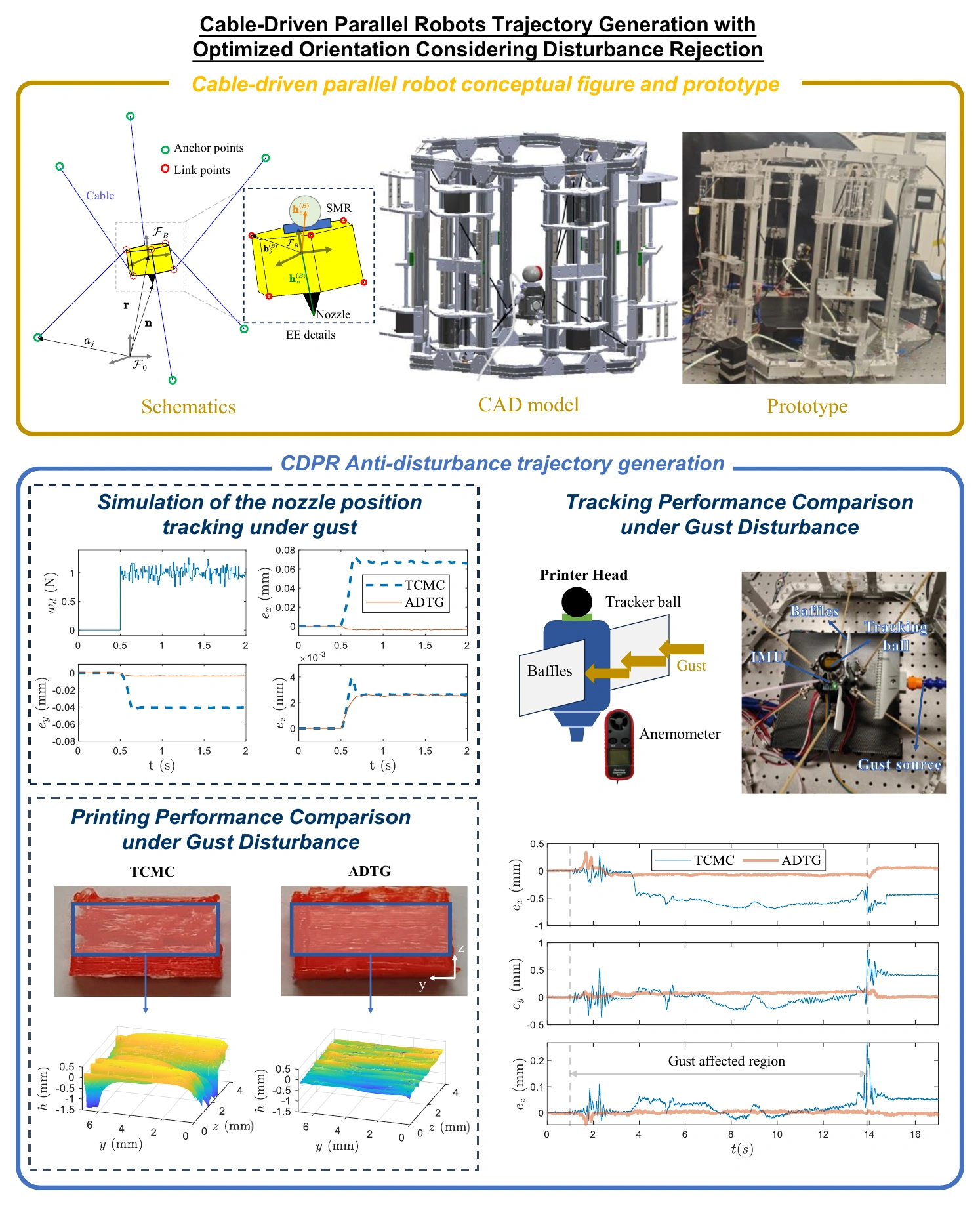
Design, modeling, and trajectory optimization of a cable-driven parallel robot (CDPR) for additive manufacturing.
The challenge
Cable-driven robots offer a flexible, scalable approach to large-workspace manufacturing. Cable elasticity and external forces can displace the printing nozzle, making accurate tracking difficult. Outdoor applications introduce an additional challenge: wind disturbances.
For printing tasks that constrain nozzle position but leave some freedom in orientation, that freedom can be used to improve the robot’s resistance to disturbances.
The approach
- Model the mechanism. Relate cable geometry, tension, and elasticity to the end-effector pose and nozzle position.
- Quantify disturbance sensitivity. Use a variation-based analytical framework to evaluate directional stiffness and the effect of external forces.
- Optimize orientation. Generate an anti-disturbance trajectory (ADTG) while maintaining the required nozzle path.
- Make it practical. Fit sampled orientation optimization results with a shallow neural network for efficient implementation.
Simulation & experimental validation
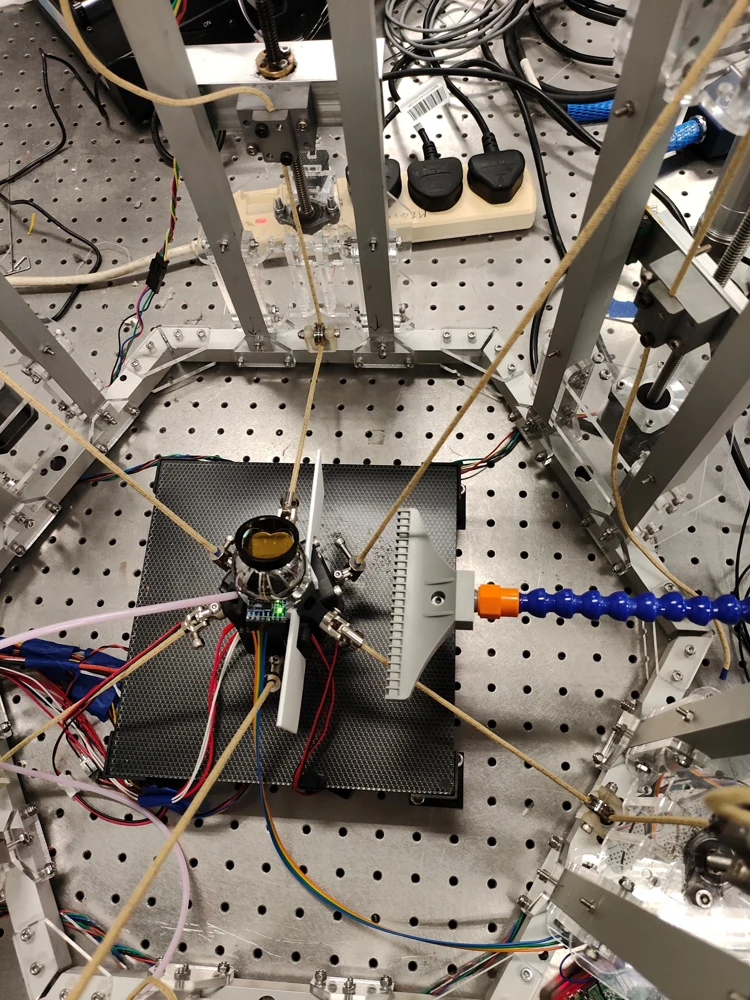
The method was evaluated using dynamic simulation and a physical CDPR with a printing end effector. Laser-tracker measurements capture nozzle motion; impact-hammer tests assess frequency response; gust experiments compare ADTG with tension-considering compensation (TCMC).
What the experiments show
Optimizing orientation improves directional stiffness and nozzle tracking under gusts. Surface scanning of the printed parts provides a second way to evaluate the effect on manufacturing quality.
TCMC baseline
Proposed ADTG method
Values from the scanned printed-part comparison in the project presentation (slide 21), describing this experimental condition.
Related publications
Shuai Liu and Molong Duan. Cable-driven parallel robot trajectory generation with optimized orientation considering disturbance rejection. Mechanism and Machine Theory, 210, 106016, 2025.
Read paper ↗
Molong Duan, Jiaquan Feng, and Shuai Liu. Design, manufacturing, modelling, and control of a cable-driven parallel robot for additive manufacturing. IEEE CASE, 2023.
Read paper ↗